
 In line with the LTA plan, Yorkshire Tennis, together with North Region, is working on strategies to encourage access for players of all abilities, embrace diversity and inclusion and promote tennis for disabled people. The Open Court Programme is a national scheme that actively promotes and delivers opportunities for disabled people to get involved in tennis. Jointly funded by Sport England, the programme provides disability specific sessions – including learning disability tennis, wheelchair tennis, visually impaired tennis and deaf tennis. The programme is being expanded into other long-term health conditions such as mental health and dementia.
Types of Disability Tennis
Visually Impaired Tennis (VI Tennis, Sound Tennis or Blind Tennis)
This is now played in 3 0 countries and has ambitions to become a future Paralympic sport. The game is played on a smaller court with a lower net. Some courts also have tactile lines so players can touch them and players also use an audible ball that makes a noise so they can hear it bounce and being hit. VI tennis is open to players of all ages, experience, fitness levels and abilities who have a visual impairment. Tennis players compete in different categories, with the B1 category having the greatest degree of sight loss. Depending on a player’s category they may have up to three bounces of the ball before they return it. Check out the VI Yorkshire Tennis League – Click here.

Learning Disability Tennis
This includes conditions such as Down’s Syndrome, Asperger’s Syndrome, Autistic Spectrum Disorder (ASD) and Attention Deficit Hyperactivity Disorder (ADHD). Each person’s learning disability has different symptoms and characteristics, so expert coaches tailor each session to the client’s needs. For those looking to compete, criteria for entry are connected to the person’s IQ, with anyone with an IQ of less than 75 eligible.
Wheelchair Tennis
One of the fastest growing wheelchair sports in the world and it’s the most fun too! It’s almost identical to tennis apart from one key rule: wheelchair tennis players are allowed to let the ball bounce twice. To give players more freedom, only the first bounce needs to be within the lines of the court as well.
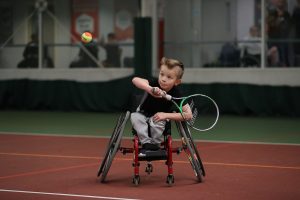
Wheelchair tennis is open to everyone – you don’t need to be a wheelchair user to play it. And both disabled and non-disabled tennis players can play together. In the professional game players undergo a classification to compete in one of two categories of wheelchair tennis: the Open and Quad divisions. Men and women compete separately in the Open division, while players with higher levels of impairment compete in the mixed Quad division.
Wheelchair tennis is played at the Paralympics as well as all the Grand Slams – and at other international tournaments as part of the ITF Wheelchair Tennis World Tour.
 Deaf Tennis
People who are deaf have different levels of hearing loss, from mild to profound deafness – but everyone is welcome in tennis. Every deaf person is different with some being hearing aid users and others having a cochlear implant, and some may sign, some may lipread, some may listen, and some may speak. Some may well do all of these. To be eligible to compete in Deaf Tennis a player has to have an average hearing loss of 55dB or more in their best ear. When competing, players must remove cochlear implants and hearing aids to ensure it is an even playing field for all.
How clubs can get involved with Disability Tennis
A package of equipment and support has been developed as part of the Open Court Programme. This includes:
Open Court Programme requires a commitment from clubs for 12 months as follows:
Any clubs/coaches/committees in Yorkshire interested in being part of the Open Court Programme should contact Ben Howarth the Yorkshire Open Court Lead: yorkshireopencourt@gmail.com.
They can provide a service that is bespoke to individual needs so will develop a plan that works for the club at a pace that can be delivered. In addition, the LTA offers an online learning module Open Your Doors providing guidance for anyone interested in setting up a disability inclusive venue.
As part of Yorkshire Tennis commitment to supporting clubs who are considering setting up disability projects, small grants can also be applied for through the Yorkshire Open Court Programme.